If you've lived in Ocala for any length of time, you've probably heard someone mention Florida's hard water. While hard water isn't typically a health concern, it can create significant problems for your home's plumbing system, especially your water heater.
At Floyd's Plumbing, one of the most common issues we see in Marion County homes is premature water heater failure caused by mineral buildup. Ocala's water tests at 15–20 grains per gallon, three to four times the national average, and your water heater is where that hardness does its worst damage.
This guide explains exactly how hard water attacks your water heater, what to watch for, and what you can do to add years to your unit's life.
What is hard water?
Hard water contains elevated levels of dissolved minerals, primarily calcium and magnesium. As water moves through the limestone layers of the Floridan Aquifer beneath Marion County, it naturally collects these minerals before entering your home's plumbing system.
While these minerals are harmless to drink, they behave differently when heated. As water temperature rises, calcium and magnesium become less soluble and precipitate out, forming solid sediment that settles wherever water sits still and hot. The bottom of your water heater tank is the perfect landing spot.
How hard water destroys your water heater from the inside
Every time your water heater heats a tank of water, a small amount of mineral sediment separates and drops to the bottom. In a soft-water area, this buildup is negligible. In Ocala, it accumulates fast.
Here's the damage cycle:
- Sediment layer forms at the bottom of the tank, between the burner/element and the water
- The layer acts as insulation: the burner runs longer to heat water through the scale blanket
- Energy bills climb: a heater with 2 inches of sediment can use 20–30% more energy
- The bottom of the tank overheats: trapped water beneath the sediment flashes to steam, causing popping and rumbling sounds
- Metal fatigues: repeated overheating weakens the tank bottom, leading to leaks or failure
- The anode rod is consumed faster: hard water accelerates anode depletion, removing the tank's only corrosion protection
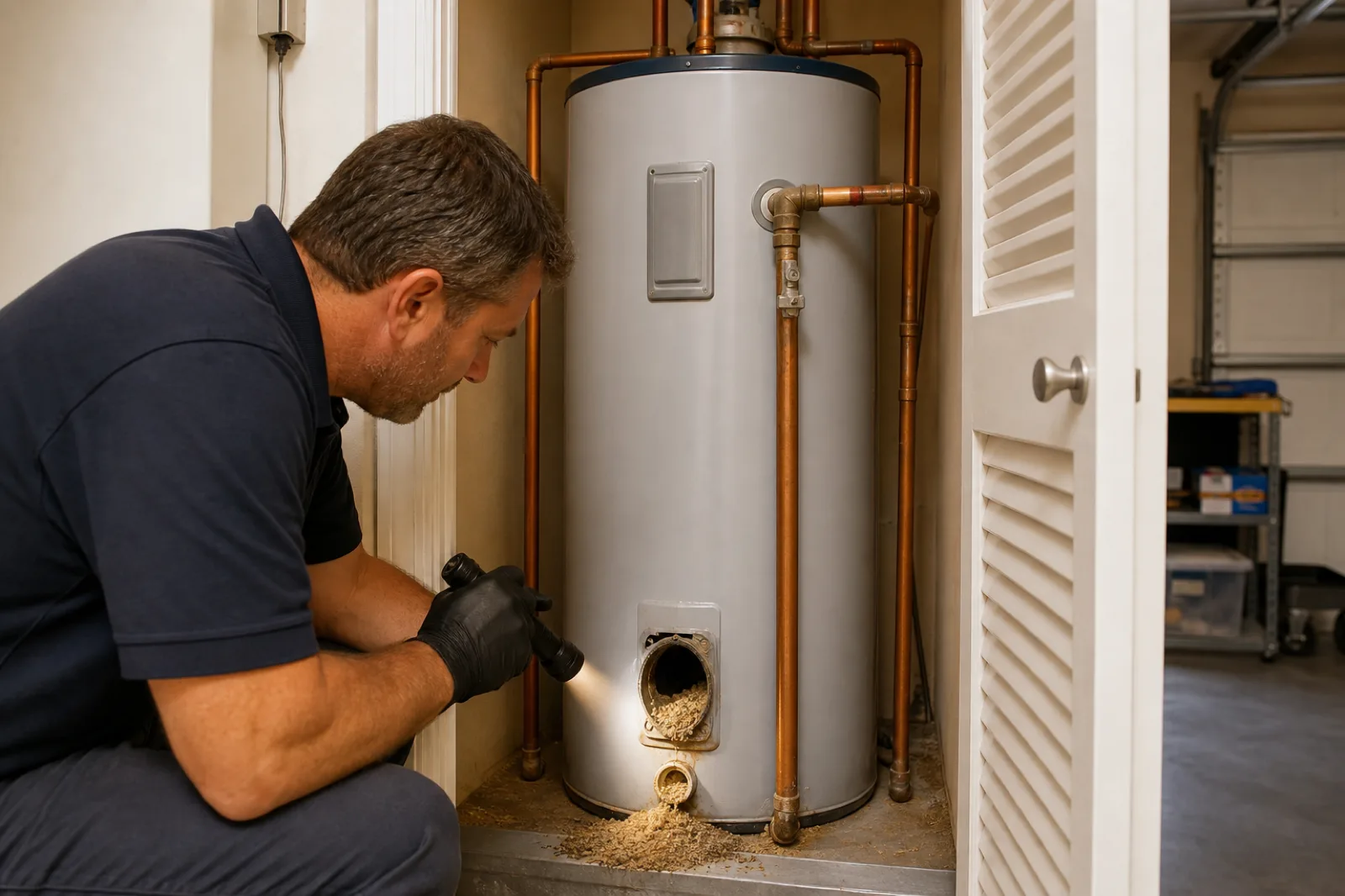
In a Marion County home without a water softener, we've opened water heaters after just 5–6 years and found 3–4 inches of solid sediment. The unit was running at roughly half its rated efficiency and was months away from a bottom failure.
Tank vs. tankless: hard water hits differently
Traditional tank water heaters
Sediment accumulates at the bottom, the hottest part of the tank. This is the most common failure mode we see. The tank itself can crack or leak from the stress. Heating elements (electric) or the gas burner area (gas) become less effective. Most tank heaters in Ocala without soft water or regular flushing last 6–8 years instead of the rated 10–12.
Tankless water heaters
Tankless units heat water on demand through a narrow heat exchanger. Hard water scale clogs those narrow passages quickly, restricting flow and reducing efficiency. Tankless manufacturers require annual descaling, and in Ocala's water, we mean it. Skip descaling for two years and you risk error codes, flow sensor failures, and a $1,500+ heat exchanger replacement. A water softener upstream of a tankless unit is the best investment you can make.
Signs your water heater has mineral buildup
Many homeowners don't realize their water heater is struggling until it fails completely. Watch for these warning signs early:
Inconsistent hot water
If your hot water runs out faster than it used to, sediment may be displacing 10–20 gallons of capacity in a 50-gallon tank. You're paying to heat a tank full of rocks and sand, not water.
Popping, cracking, or rumbling sounds
This is the classic symptom. Water trapped beneath the sediment layer flashes to steam and collapses back, creating the popping sound. If your water heater sounds like a popcorn machine, it needs to be flushed immediately.
Rising utility bills
Compare your electric or gas bill year over year. If usage is climbing but your habits haven't changed, your water heater is a prime suspect. A scale-coated element or burner works harder for the same result.
Discolored hot water
Rusty or cloudy hot water (while cold water runs clear) points to corrosion inside the tank, often accelerated by sediment exposing bare metal and depleting the anode rod. If hot water looks different from cold, call us.
Visible leaks at the base
Once sediment causes the tank bottom to overheat and fatigue, micro-cracks form. You'll see moisture, rust, or pooling water at the base of the unit. At this point, replacement is usually the only option. Flushing won't fix a cracked tank.
Can hard water damage other plumbing?
Absolutely. The water heater is just the most expensive casualty. Hard water also contributes to:
- Faucet aerator and showerhead clogs: white mineral deposits choke flow at individual fixtures
- Reduced water pressure: decades of scale buildup narrows pipe diameter house-wide
- Dishwasher and washing machine inefficiency: heating elements scale up, valves stick
- Soap and detergent waste: hard water neutralizes soap, so you use more and get less
- White deposits on fixtures: the crusty buildup around faucet bases and shower handles
For a broader look at how hard water affects your entire home, read our Marion County hard water guide.
How to protect your water heater
Annual flushing
Draining 5–10 gallons from the tank drain valve every 6–12 months removes loose sediment before it compacts into a solid layer. This is the single most effective maintenance step for tank water heaters in hard water areas. We include a flush with every water heater service call.
Anode rod inspection
The anode rod is a sacrificial metal rod inside the tank that attracts corrosion so the tank walls don't rust. In hard water, anodes deplete 2–3 times faster. We check the anode during maintenance and replace it when it's more than 50% consumed. A $50 anode rod can add 3–5 years to a tank's life.
Water softener
A whole-home softener removes the calcium and magnesium before they reach your water heater. This is the most effective long-term protection. For Ocala homeowners, a softener plus annual flushing is the combination that gets water heaters to their full rated lifespan and beyond.
Tankless descaling
If you have a tankless unit, annual descaling with a vinegar or commercial descaling solution pumped through the heat exchanger is required, not optional. We offer tankless descaling as a standalone service or as part of an annual maintenance plan.
Temperature setting
Keep your water heater at 120°F. Higher temperatures accelerate scale formation and increase the risk of scalding. There's no benefit to running at 140°F in a residential home.
When should you replace your water heater?
Most traditional tank water heaters are rated for 8–12 years. In Ocala's hard water without treatment, expect the lower end of that range. Consider replacement if:
- The unit is 8+ years old and showing any of the warning signs above
- You've flushed it and the popping sounds return within months
- There's rust or moisture at the base of the tank
- Repair costs exceed 50% of a new unit. A $600 repair on a 10-year-old heater doesn't make sense when a new one is $1,200–$1,800 installed
- Your family has outgrown the tank size (a family of four needs at least 50 gallons; five or more should look at 65–80)
When we replace a water heater, we always recommend installing a drain pan, a new expansion tank if required, and if you don't have one, a water softener to protect the new unit from day one.
Schedule a water heater inspection
Whether you need a flush, an anode rod replacement, a repair, or a full unit replacement, Floyd's Plumbing has served Ocala and Marion County homeowners for years with honest recommendations and reliable service. If your water heater isn't performing like it should, or if you just want to know how much sediment is sitting at the bottom of your tank, give us a call. An inspection takes about 30 minutes and tells you exactly where you stand.