The water coming out of your tap in Ocala is generally safe, clean, and delicious, but it's also hard. Really hard. Marion County sits on top of the Floridan Aquifer, one of the most productive groundwater sources in the world, and that aquifer is loaded with dissolved calcium and magnesium picked up from the limestone that makes up most of Florida's subsurface geology.
Hard water isn't a health hazard. You can drink it, cook with it, and bathe in it without concern. But it is absolutely a plumbing hazard, and over the years, it quietly costs Marion County homeowners thousands in wasted energy, shortened appliance life, and clogged fixtures.
How hard is Ocala water?
Water hardness is measured in grains per gallon (gpg). Here's the scale:
- 0–1 gpg: Soft
- 1–3.5 gpg: Slightly hard
- 3.5–7 gpg: Moderately hard
- 7–10 gpg: Hard
- 10+ gpg: Very hard
Most city connections in Ocala test between 15 and 20 gpg, firmly in the "very hard" category. Well water in rural Marion County can test even higher, often 20–30 gpg, and frequently adds iron (orange staining) and sulfur (rotten egg smell) to the mix.
For context, the national average is about 5 gpg. Ocala's water is three to four times harder than what most of the country deals with. If you moved here from somewhere else and noticed your soap doesn't lather, your glasses come out of the dishwasher cloudy, and your skin feels dry. That's hard water, not your imagination.
What hard water actually does to your home
The minerals in hard water don't stay dissolved forever. When water is heated or evaporates, calcium and magnesium come out of solution and stick to everything they touch. Over months and years, the damage compounds.
Water heaters
Sediment settles at the bottom of the tank and acts as an insulator between the burner and the water. A water heater with 2 inches of scale at the bottom can lose 20–30% of its heating efficiency, which means higher electric or gas bills every month. We cover this in detail in our water heater and hard water guide.
Tankless water heaters
Tankless units are even more vulnerable. The heat exchanger has narrow passages that scale clogs quickly. Without treatment, a tankless water heater in Ocala's hard water can fail in 3–5 years instead of the 15–20 years it's designed to last. Annual descaling is non-negotiable for tankless owners in Marion County.
Fixtures and faucets
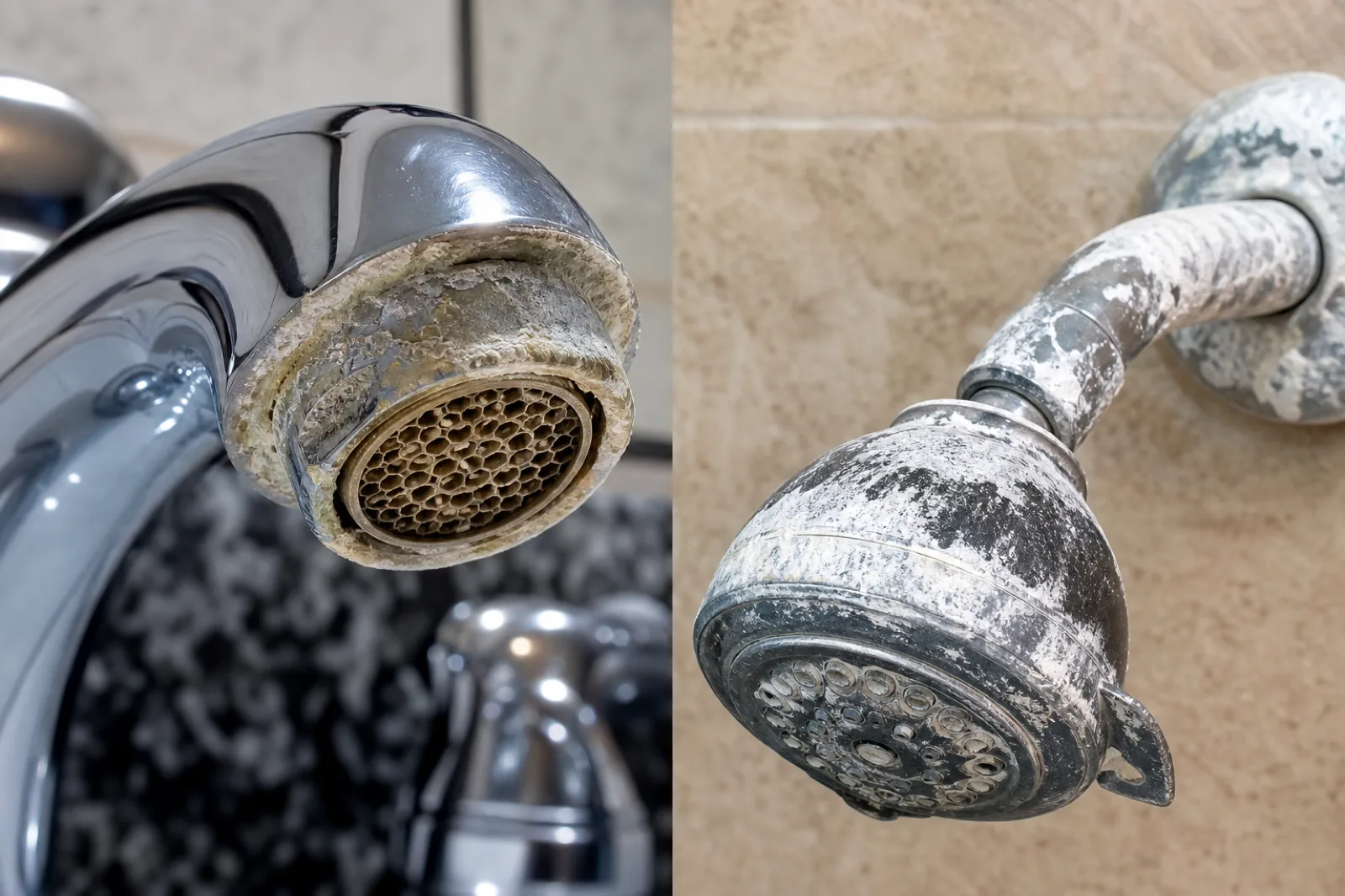
Showerheads, faucet aerators, and mixing valves clog with white mineral deposits. You'll notice pressure dropping at individual fixtures long before the main lines are affected. Soaking aerators in vinegar helps temporarily, but the buildup returns within weeks.
Pipes
Over decades, scale narrows the inside diameter of copper and galvanized pipes. This reduces flow and pressure house-wide. In extreme cases, we've opened pipes in older Ocala homes and found the inside diameter reduced by half.
Appliances
Dishwashers, washing machines, and ice makers all suffer. Heating elements scale up. Valves clog. Manufacturer warranties often exclude damage from hard water, meaning you're paying for repairs that the warranty won't cover.
Cosmetic annoyances
White spots on glassware, chalky streaks on shower doors, stiff laundry, faded colors, and soap that won't lather. These aren't dangerous, but they affect your daily quality of life and are the symptoms most people notice first.
City water vs. well water in Marion County
The treatment approach depends on your water source:
- City of Ocala water: Treated at the plant for bacteria and chlorine, but not softened. You get the full hardness straight from the aquifer. A standard ion-exchange water softener is the fix.
- Well water: Untreated except for whatever your own system does. Often harder than city water, plus iron and sulfur. Requires testing before sizing any treatment system. We do this on-site for free.
- Community wells (Marion Oaks, etc.): Varies by system. Some community wells are moderately hard, others are extreme. Test before you buy a softener.
How to fix hard water: your options
Whole-home water softener (recommended)
An ion-exchange softener is the gold standard. It runs your water through a resin bed that swaps calcium and magnesium ions for sodium (or potassium) ions. The result is genuinely soft water throughout the entire house.
We test your water on-site, measure your household's peak usage, and size the unit accordingly. An undersized softener regenerates too often and wastes salt. An oversized one is money you didn't need to spend.
Cost: A properly sized whole-home softener is usually $1,800–$2,800 installed in Marion County, depending on capacity and whether pre-treatment is needed for iron or sulfur.
Maintenance: Add salt (or potassium chloride) every 4–8 weeks. Annual service check to clean the brine tank and verify regeneration timing. That's it.
Salt-free conditioners
Template-assisted crystallization (TAC) units don't remove hardness. They change the crystal structure so minerals don't stick to surfaces as easily. They reduce scale buildup but don't give you the "soft water feel" (slick skin, better soap lather). Good for homeowners who want scale protection without adding sodium to their water.
Point-of-use filters
Under-sink reverse osmosis (RO) systems produce excellent drinking water but only at one faucet. They don't protect your water heater, pipes, or other fixtures. Useful as a complement to a softener, not a replacement.
Doing nothing
You can live with hard water. Plenty of Marion County homeowners do. But understand the cost: shorter appliance life, higher energy bills, more frequent fixture replacements, and eventually pipe scaling that contributes to pressure loss. Over 10 years, doing nothing often costs more than installing a softener would have.
Is a water softener worth it?
For most Ocala homeowners, yes. Here's the math:
- Softener install: ~$2,000–$2,800
- Annual salt and service: ~$100–$150
- Water heater life extension: 3–5 extra years (a $1,500–$3,000 savings)
- Energy savings from a scale-free heater: $10–$20/month
- Fixture and appliance longevity: harder to quantify, but real
Most homeowners see a return on investment within 3–5 years, and the daily quality-of-life improvement is immediate.
Get your water tested
We offer free on-site water testing in Ocala and Marion County. We'll tell you your exact hardness level, check for iron and sulfur if you're on a well, and recommend the right system for your home and budget. No pressure, no gimmicks, just numbers and an honest recommendation.