
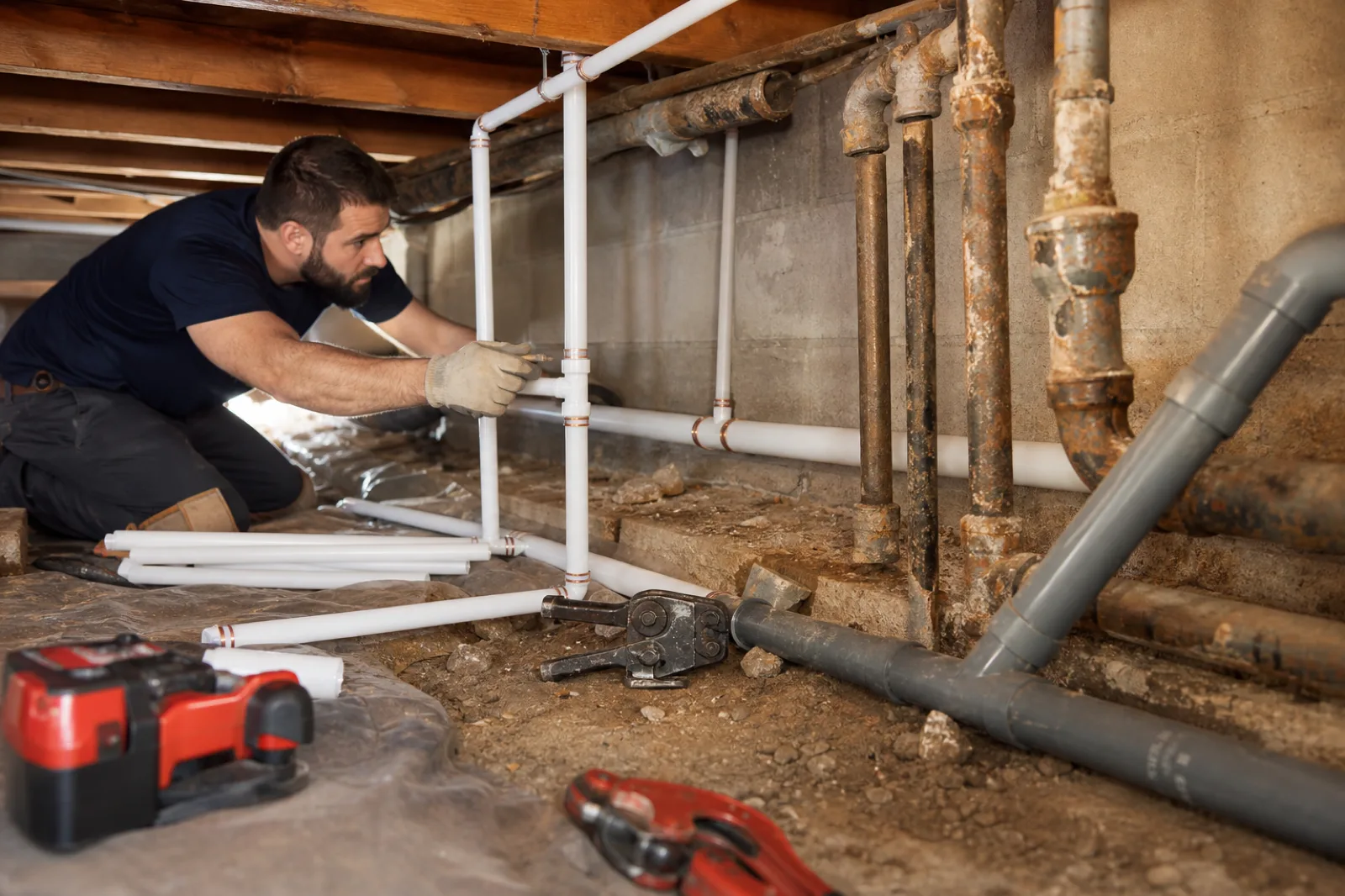
A whole-home repipe is a big project, and nobody does one unless they have to. That said, there are warning signs that tell you another patch is just throwing money at a system that's reaching end of life. In Ocala and Marion County, we see three pipe generations in homes built from the 1960s through the early 2000s: galvanized steel, polybutylene, and copper. Each one fails in its own predictable way.
Knowing which pipe you have and what stage of failure it's in can save you from an emergency call at 2 AM and help you plan (and budget) for the right fix.
What pipe is in your Ocala home?
Before you can read the warning signs, it helps to know what you're working with:
- Galvanized steel (pre-1970s): Common in Ocala's older neighborhoods: Tuscawilla, the historic district, and early Pine Oaks builds. Gray metal pipe that corrodes from the inside out. Most of it is well past its useful life.
- Polybutylene (1978–1995): Gray or blue-gray flexible plastic. Installed in huge volumes during Ocala's building boom. Prone to sudden failure at fittings and elbows with no warning.
- Copper (1970s–2000s): Still the gold standard when properly installed. But in Marion County's hard water at high pressure, copper develops pinhole leaks, especially if the PRV failed or was never installed.
- PEX (2000s–present): Flexible plastic, color-coded (red for hot, blue for cold). If your home already has PEX, you likely don't need a repipe unless there was a bad install.
Not sure what you have? Check under a sink or behind the water heater. Or call us for a free pipe assessment. We can tell you in about 10 minutes.
1. Pinhole leaks in copper
A pinhole leak is exactly what it sounds like: a tiny hole that sprays a fine mist or drip from an otherwise solid-looking copper pipe. They're deceptive because the pipe looks fine on the outside while the inside has been eaten away by erosion corrosion, accelerated by Marion County's hard water.
If you've had more than one pinhole leak in the past two years, it's very likely your pressure-reducing valve (PRV) failed and your house is running at 100+ PSI. Municipal pressure in Ocala can hit 80–120 PSI at the street. Your home's plumbing is designed for 50–60 PSI. That extra pressure blasts through thin spots in copper pipe like a pressure washer through a paper towel.
What a patch costs vs. a repipe: Each pinhole repair runs $200–$400. By the third leak, you've spent nearly what a partial repipe would cost, except the rest of the pipe is the same age and condition as the section that just failed. A full repipe in PEX usually pays for itself before the third leak, and you stop worrying about which wall is next.
2. Polybutylene (gray plastic) pipe
If your home was built between 1978 and 1995 and you see gray plastic pipe at any fixture, you probably have polybutylene, often called "poly-B." It was marketed as the pipe of the future. It wasn't.
Poly-B fails at fittings, elbows, and anywhere it was bent too sharply during install. The failure is often sudden and catastrophic, not a slow drip but a full burst. It was the subject of one of the largest class-action settlements in US construction history (Cox v. Shell, $1.1 billion). That settlement has long since expired, so every poly-B failure is now entirely on the homeowner.
Insurance implications: Insurance companies know what poly-B is. Some won't renew policies on homes still running it. Some require a repipe before issuing coverage. If you're buying or selling a home in Marion County, poly-B is one of the first things a home inspector flags.
Our recommendation: If you have poly-B, don't wait for it to fail. Plan a repipe on your terms, not at 2 AM on a Saturday.
3. Rusty or discolored water
Turn on a faucet in the morning and the water comes out brown, orange, or yellow for a few seconds before clearing up? That's your pipes talking. On galvanized pipe, common in Ocala homes built before 1970, the inside corrodes from the inside out. Rust flakes break loose and ride the water stream to your tap.
By the time the water is visibly discolored, the pipe walls are already dangerously thin. The discoloration is the symptom, not the disease. The disease is a pipe that's nearing the end of its structural life and could burst without further warning.
On copper, blue-green staining at fixtures points to a different problem: acidic water eating the pipe from the inside. Less common locally but worth watching for.
4. Pressure keeps dropping
Low water pressure is one of the most common complaints we hear in Marion County, and it has several causes. Before you assume you need a repipe, rule these out:
- Failed PRV: If pressure is too high, the PRV may have failed open. If it's too low, it may be clogged or adjusted wrong. A PRV replacement is $300–$500, much cheaper than a repipe.
- Clogged aerators or showerheads: Hard water mineral buildup can choke fixtures. Soak them in vinegar overnight before assuming the pipes are the problem.
- Partially closed valves: Someone turned a shut-off valve most of the way off and forgot. Check your main and fixture valves.
If you've ruled all of those out and pressure is still low throughout the house, not just at one fixture, the pipes themselves may be closing down from decades of mineral buildup or internal corrosion. That's a repipe conversation.
5. Multiple repairs in one year
This is the simplest math in plumbing. If you've called us (or anyone) more than twice in the past year for leaks in different locations, the system is telling you it's done with patchwork. Each repair is a band-aid on a pipe that's the same age and condition as the one that just failed.
We had a customer in Silver Springs Shores who had four copper pinhole repairs in 14 months: $1,400 total in patches. A full repipe cost $4,200 and came with a warranty. They haven't had a leak since.
What a whole-home repipe actually looks like
We know "repipe" sounds like a demolition project. In most Ocala homes, it's not. Here's what to expect:
- Timeline: Most whole-home repipes in Ocala run 2 to 4 days. Water is restored every night, so you're never without water overnight unless something unusual comes up.
- Material: We use PEX-B (cross-linked polyethylene) for nearly all residential repipes. It flexes around obstacles, resists scale buildup from hard water, and comes with a 25-year manufacturer warranty.
- Access: We run new lines through attics, crawlspaces, and behind walls using existing access points. We cut drywall only where necessary and patch it when we're done.
- Permits: We pull the permit, schedule the inspection, and handle the paperwork. You don't need to deal with the county.
- Cleanup: We vacuum, haul debris, and leave the work area cleaner than we found it. That's not a slogan. It's what our guys are trained to do.
Slab leaks: the wildcard
Ocala's housing stock includes a lot of slab-on-grade construction, especially in neighborhoods built from the 1970s through the 1990s. In slab homes, some water lines are encased in the concrete foundation. When those leak, you may notice warm spots on the floor, unexplained water bills, or the sound of running water when nothing is on.
Slab leaks don't always require a full repipe. Sometimes we can reroute the affected line through the attic and abandon the slab section. But if the home has poly-B under the slab, a full repipe is almost always the right call.
Get a free repipe estimate
We offer free repipe estimates with a written scope of work and a firm price, with no surprises. We're also adding financing options for larger projects, so ask about that when you call. If you're seeing any of the five signs above, it's worth a conversation. The estimate costs you nothing, and the peace of mind is worth a lot.