
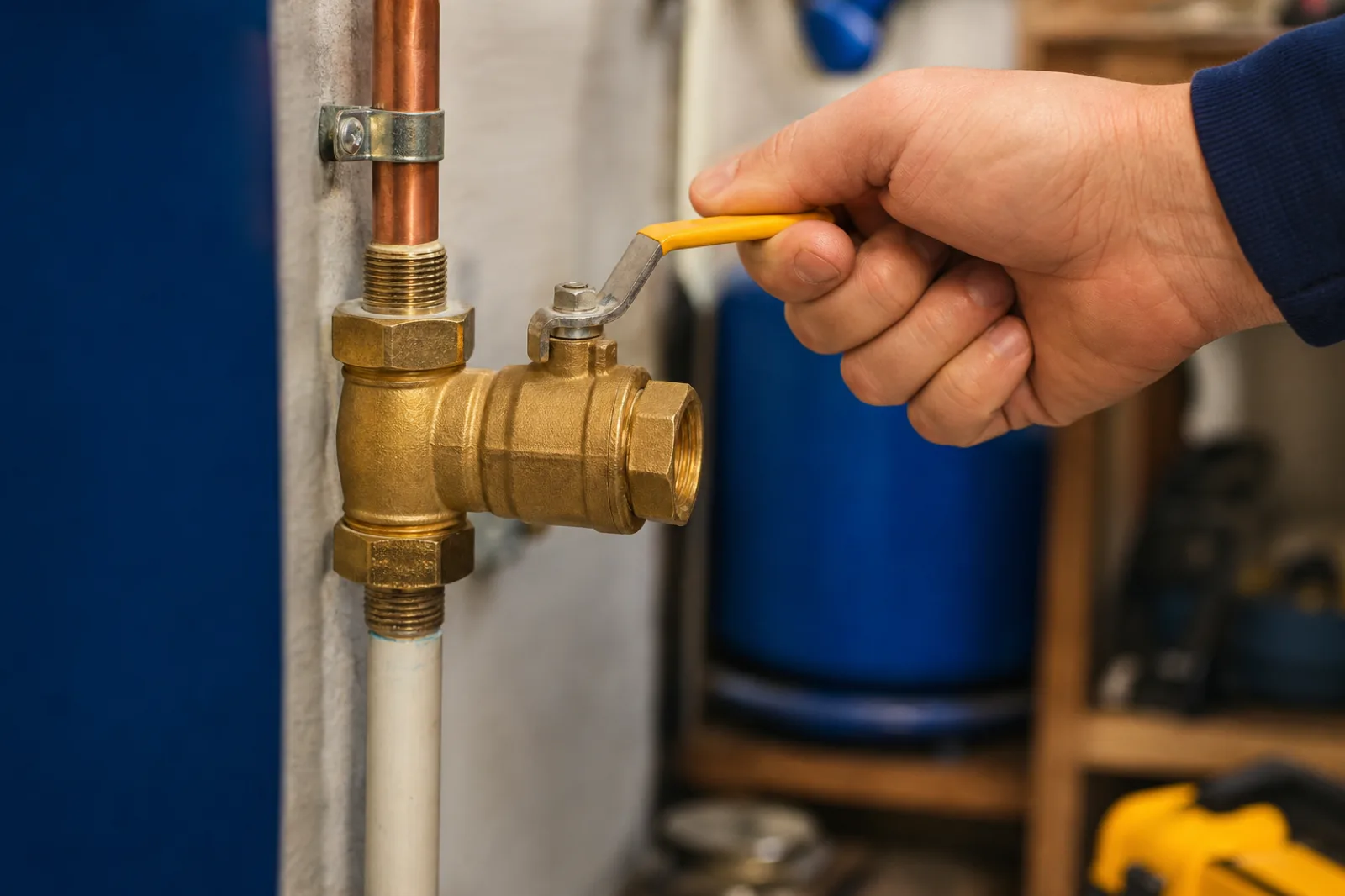
The single most important skill a homeowner can have is knowing how to shut off their water. When a pipe bursts, a toilet overflows, or a water heater fails, every minute counts. Most water damage happens in the first 10 minutes, and in Marion County, where many homes sit on slab foundations with limited crawlspace access, a burst line can soak drywall, flooring, and insulation before you even figure out where the valve is.
This guide walks you through every shut-off in a typical Ocala home, when to use which one, and what to do in the minutes between shutting off the water and our truck arriving.
Know your shut-offs before you need them
Most homeowners have never touched their main shut-off. That's normal, until it isn't. Take 15 minutes this weekend to locate every valve in your house and test the ones you can reach. Write down the locations on a piece of tape inside your utility closet or garage panel. Future-you will be grateful.
Your main house shut-off
On a city water connection in Ocala, your primary shut-off is usually near where the main line enters the house. Common locations in Marion County homes:
- Garage wall: Very common in Ocala ranch-style and newer construction. Look for a pipe coming through the exterior wall with a valve handle nearby.
- Utility closet or laundry room: Often paired with the water heater or washing machine hookups.
- Outside near the meter: Some older homes in neighborhoods like Tuscawilla, Pine Oaks, and the historic district have the shut-off on an exterior wall closest to the street.
- Crawlspace or attic: Less common locally, but some split-level and two-story homes route the main line overhead or below.
The valve itself will be one of two types:
- Ball valve: A lever handle. Parallel to the pipe = open. Turn it a quarter turn so the handle is perpendicular to the pipe = closed. This is the best type. Fast, reliable, and easy to operate under stress.
- Gate valve: A round wheel handle. Takes multiple full rotations to close. Common on older homes. These seize up over time. If yours hasn't been turned in years, it may not close fully when you need it.
The street shut-off (meter box)
Every Ocala home on city water also has a shut-off in the meter box at the curb. This is your backup if the house valve fails or you can't find it. The box is usually a rectangular concrete or plastic lid flush with the ground near the street.
Opening it requires a meter key, a long T-handle tool that lifts the lid and operates the valve inside. We recommend keeping one in the garage. They cost about $15 at any hardware store and take up almost no space.
Inside the box you'll see the water meter and a valve on the house side of it. Turn it clockwise to shut off. Important: The utility's valve on the street side of the meter is technically their property. Use the house-side valve unless it's an absolute emergency and your house valve won't close.
Well system shut-offs
If you're on a well, common in rural Marion County areas like Fort McCoy, Sparr, and Weirsdale, your shut-off is usually next to the pressure tank in a pump house, garage, or utility closet. Look for a valve on the pipe between the tank and the house.
On a well, you also have a second option: kill power to the pump at the breaker. The pump will stop pushing water, which stops the leak even if you can't reach the valve. Know which breaker controls your well pump and label it.
Individual fixture shut-offs
Not every leak requires shutting off the whole house. Most fixtures have their own local shut-off, and using the right one can save you from a cold shower or a night without any water at all.
Toilets
Look behind the toilet near the floor. There's a small oval handle on the supply line. Turn it clockwise. This stops water to that toilet only. Use this for an overflowing toilet or a leaking fill valve.
Sinks
Under the vanity, two small oval handles on the supply lines: one hot, one cold. Turn both clockwise. Kitchen sinks usually have the same setup inside the cabinet below.
Washing machine
Two lever or oval handles behind the washer where the hoses connect. Shut both off. If a supply hose bursts, these valves can prevent thousands of dollars in laundry room damage.
Water heater
A valve on the cold water inlet pipe at the top of the unit. Shutting this off stops water from entering the tank but doesn't drain what's already inside. If the tank itself is leaking, also kill power (electric) or set gas to pilot/off at the unit.
How to shut off water: step by step
- Stay calm and locate the leak. Is it a single fixture or a pipe in the wall?
- Use the closest shut-off. Fixture valve first if the leak is isolated. Main house valve if it's a pipe burst or you can't tell where it's coming from.
- Turn clockwise (righty-tighty) until the valve stops. Ball valve = quarter turn. Gate valve = keep turning until it won't go further.
- Open a faucet at the lowest point in the house to drain residual pressure from the lines. This slows any remaining drip.
- Kill power to the water heater at the breaker if the leak is anywhere near the unit or in the hot water line.
- Move valuables away from the wet area and set towels or buckets if water is still dripping.
- Take photos of all visible damage for your insurance claim before anything dries or gets moved.
- Call us. Even if you've stopped the leak, the repair still needs to happen. Hidden moisture causes mold fast in Florida's humidity.
Common mistakes we see
- Only shutting off one supply line. If a pipe burst in the wall, a fixture shut-off won't help. Go to the main.
- Forcing a seized valve. If the handle won't budge, don't break it off. Use the meter box shut-off or call us. We carry pipe freeze kits and can isolate sections without a working main valve.
- Forgetting the water heater. A leak near the heater with the power still on is a safety hazard. Always hit the breaker.
- Not testing valves ahead of time. A valve that hasn't moved in 10 years may not close all the way. Test yours annually.
- Waiting too long to call. Shutting off the water is step one, not the finish line. Corroded pipes, failed fittings, and slab leaks all need professional repair.
When to call a plumber vs. handle it yourself
Shutting off the water is always a DIY job. Every homeowner should know how. Repairing the leak is where the line is. Call us if:
- The leak is inside a wall, under the slab, or in the main line
- Your shut-off valve is broken or won't close fully
- Water is near electrical panels, outlets, or your HVAC system
- You see mold, sagging drywall, or water spreading across multiple rooms
- The same fixture or pipe has leaked before. It's telling you something
Test your shut-off this weekend
If you've never tested your shut-off, do it now, before you need it. Turn the main valve off, open a faucet to confirm the flow stops, then turn it back on. If the valve is stiff, a shot of penetrating oil and gentle back-and-forth movement can free it up. If it won't turn at all, we can replace it with a modern quarter-turn ball valve in under an hour. That's one of the cheapest insurance policies you'll ever buy.