If you have an irrigation system, a commercial building, a fire sprinkler system, or certain types of residential connections in Marion County, you probably have a backflow prevention assembly somewhere on your property. And if you do, Florida law requires that assembly to be tested every year by a certified tester, with the results filed directly with your water utility.
It's not optional, it's not a suggestion, and missing your test date can result in fines, water shutoffs, and in commercial settings, failed health inspections. Here's everything you need to know.
What is backflow, and why does it matter?
Your plumbing system is designed so water flows in one direction: from the public supply, through your pipes, out your fixtures. Backflow is when that flow reverses, and contaminated water gets sucked back into the clean public supply.
This isn't theoretical. It happens when there's a sudden pressure drop in the main line: a water main break, a fire hydrant opened nearby, or a pump failure. When pressure drops, water in your pipes can flow backward. If that water has been in contact with fertilizer, pesticides, boiler chemicals, or sewage, it goes straight into the public drinking supply.
Real-world examples that drove backflow laws:
- An irrigation system without a backflow preventer pulled lawn chemicals into a neighborhood's drinking water
- A commercial boiler's chemical treatment backflowed into the city main during a pressure event
- A residential hose submerged in a pool (with the spigot open) siphoned pool water into the supply line
Backflow prevention assemblies are the physical barrier that stops this. The annual test proves they're still working.
Who needs backflow testing in Marion County?
If any of the following apply to your property, you almost certainly have a backflow assembly that needs annual testing:
- Irrigation system: The most common residential trigger. Any in-ground sprinkler system connected to city water needs a backflow preventer and annual test.
- Commercial building: Restaurants, offices, salons, medical offices, car washes. If it has a commercial water connection in Ocala or Marion County, there's a backflow assembly.
- Fire sprinkler system: Buildings with fire suppression have dedicated backflow assemblies that require their own annual test.
- Boiler or water treatment system: Any connection where chemicals are introduced to water.
- Private well with a city water backup: Dual-supply setups need backflow protection on the city side.
- Residential pool fill line: Some utilities require backflow protection on dedicated pool fill connections.
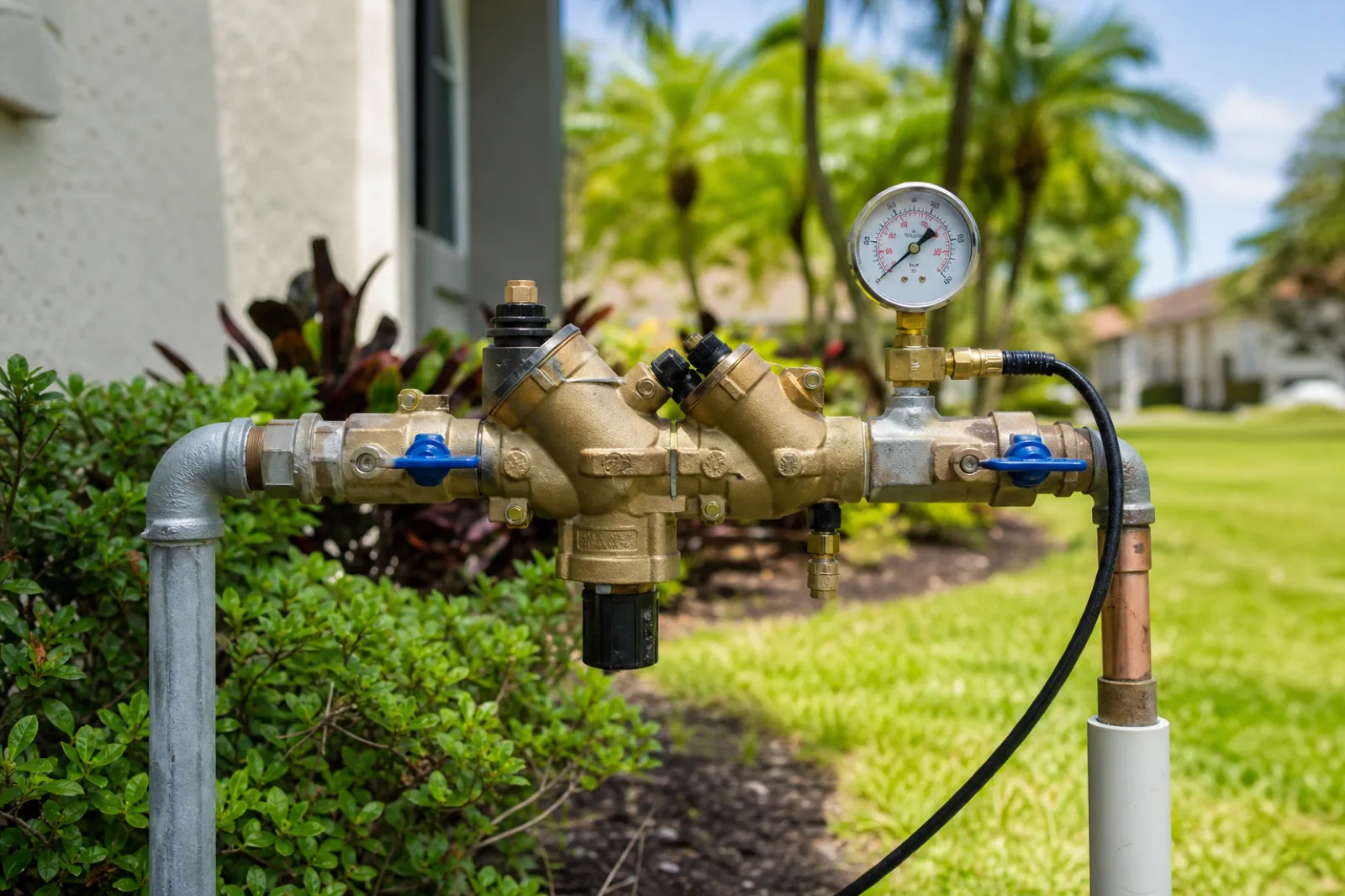
Not sure if you have one? Check near your water meter, irrigation vacuum breaker box, or the point where your sprinkler system's main line connects to the house supply. It's usually a brass or bronze device about the size of a shoebox.
Types of backflow assemblies
Not all backflow preventers are the same. The type installed on your property depends on the hazard level of your connection:
- PVB (Pressure Vacuum Breaker): Common on residential irrigation. Installed above ground, usually in a green box near the meter. Simple and reliable, but must be 12 inches above the highest sprinkler head.
- DCVA (Double Check Valve Assembly): Used on lower-hazard commercial and residential connections. Two independent check valves in series. Installed horizontally, often in a utility room or underground vault.
- RPZ (Reduced Pressure Zone): The highest level of protection. Required on high-hazard connections: commercial kitchens, medical facilities, industrial sites. Has two check valves plus a relief valve that dumps water if either fails. Required on most commercial buildings in Ocala.
Each type has a different test procedure and different rebuild kit. Our testers are certified on all three.
How the annual test works
A certified backflow tester (Florida requires specific certification through the FDEP-approved program) arrives with a calibrated test kit, a set of gauges that measure pressure differential across the check valves.
The process:
- Shut off downstream water to isolate the assembly
- Connect test gauges to the test cocks (small ports built into the assembly)
- Verify check valve #1 closes and holds against back pressure
- Verify check valve #2 closes and holds against back pressure
- Verify the relief valve opens at the correct pressure differential (RPZ only)
- Record results on a state-standard test report form
- File the report with your water utility: City of Ocala, Marion Oaks, Belleview, or whichever provider serves your address
The test takes 15 to 30 minutes per assembly. If you have multiple assemblies (irrigation plus fire suppression, for example), each one is tested separately. We file the paperwork directly with your utility so you don't have to.
What does backflow testing cost?
In the Ocala and Marion County market, expect to pay $75–$150 per assembly per year for the test, filing, and report. If the assembly needs a rebuild (springs and seals), add $50–$120 for parts and labor. A full assembly replacement runs $350–$800 depending on the type and location.
We offer annual backflow testing contracts for commercial properties with multiple assemblies: one scheduled visit, all devices tested, all paperwork filed. Ask about it when you call.
What if your assembly fails the test?
Don't panic. Most failures are fixable without replacing the whole unit. The most common causes:
- Worn seals and springs: Fixed with a rebuild kit. We carry kits on the truck for the common models: Watts 909, Wilkins 975XL, Febco 860, and Zurn 375. Rebuild takes about 30 minutes.
- Debris in the check valves: Sand, sediment, or mineral buildup preventing the valve from seating. A cleaning and rebuild usually solves it.
- Corroded body: If the assembly housing is corroded or cracked, replacement is the only option. We install the new unit and file the updated registration with your utility.
- Frozen or damaged relief valve (RPZ): Florida freezes are rare but relief valves can seize from mineral buildup. Rebuild or replace.
After a repair or replacement, the assembly must be retested to confirm it passes. We handle the retest as part of the repair, with no second trip charge.
What happens if you miss your test date?
Florida utilities take backflow compliance seriously. Here's the typical escalation:
- Reminder notice: 30–60 days before your due date, the utility sends a letter or email
- Overdue notice: If the test isn't filed by the due date, a second notice with a deadline (usually 30 days)
- Fine: $50–$250 depending on the utility and how far past due you are
- Water shutoff: If the test still isn't filed, the utility can and will shut off your water service until compliance is restored
For commercial properties, an overdue backflow test can also trigger a failed health inspection, which means you can't operate until it's resolved.
We send automatic reminders to our backflow customers before their due date. If you're on our annual testing program, you won't miss a deadline.
Schedule your backflow test
Whether you're a homeowner with an irrigation system or a business owner with multiple commercial assemblies, we make the process simple: one call, one visit, paperwork filed. We're certified, we're local, and we've been testing backflow assemblies across Ocala and Marion County for years. Call us to schedule or to set up an annual testing contract.